Technical Analysis AI for Forex: 20+ Indicators Explained
Technical Analysis AI for Forex: 20+ Indicators Explained
Technical analysis in forex involves studying price charts and using mathematical indicators to identify patterns and predict future price movements. It's based on the premise that market action discounts everything—price reflects all known information, and patterns tend to repeat.
Ai technical analysis forex takes this further by processing vast amounts of data simultaneously. These forex technical indicators ai systems identify complex patterns that humans might miss. It doesn't replace technical analysis—it augments it with speed and comprehensiveness.
ForexGPT's automated technical analysis processes 20+ technical indicators across 5+ timeframes to provide comprehensive market analysis. As a technical analysis tool forex traders can use for free, it covers the full indicator spectrum. Let's explore the tools available and how AI enhances technical analysis.
Core Technical Indicators in AI Analysis
Technical indicators fall into several categories, each serving a different purpose in analysis.
Trend Indicators
Trend indicators identify the direction and strength of price movement.
Moving Averages (SMAs 7/14/50/100):
- SMA 7: Short-term trend direction
- SMA 14: Near-term momentum
- SMA 50: Medium-term trend
- SMA 100: Longer-term trend direction
Moving Average Crossover: When shorter MA crosses above longer MA, it signals bullish momentum; downward cross signals bearish momentum.
Moving Average Ribbon: Multiple EMAs displayed together show trend strength and potential reversals.
Momentum Oscillators
Momentum oscillators measure the speed and strength of price movement.
RSI (Relative Strength Index):
- Range: 0 to 100
- Overbought: Above 70
- Oversold: Below 30
- Divergence: Price makes new high but RSI doesn't = potential reversal
Stochastic Oscillator:
- Range: 0 to 100
- Overbought: Above 80
- Oversold: Below 20
- Signal line: 3-period moving average of %K
MACD (Moving Average Convergence Divergence):
- MACD line: EMA12 - EMA26
- Signal line: EMA9 of MACD line
- Histogram: MACD - Signal line
- Crossover: Bullish when MACD crosses above signal
CCI (Commodity Channel Index): Measures the deviation of price from its statistical mean, identifying overbought and oversold conditions.
Williams %R: Momentum indicator measuring overbought/oversold levels on a scale of -100 to 0.
Awesome Oscillator: Measures market momentum using the difference between short and long-period simple moving averages.
Volatility Indicators
Volatility indicators measure the rate and magnitude of price changes.
Bollinger Bands:
- Upper band: SMA + 2 standard deviations
- Lower band: SMA - 2 standard deviations
- Bandwidth: Measures volatility
- Squeeze: Narrow bands indicate potential breakout
ATR (Average True Range):
- Range: 0 to 100%
- Measures: Average price range over a period
- Uses: Position sizing, stop placement, breakout confirmation
Channel and Trend Indicators
Additional indicators for identifying trend direction and channel boundaries.
Donchian Channels:
- Upper channel: Highest high over a period
- Middle channel: Average of upper and lower
- Lower channel: Lowest low over a period
- Breakout identification: Price breaking above/below channels signals momentum
Keltner Channels: Volatility-based envelopes set above and below an EMA, useful for identifying trend direction and potential breakouts.
Parabolic SAR: Plots stop-and-reverse points on the chart, indicating potential trend direction changes.
Ichimoku Cloud: Multi-component indicator providing support/resistance, trend direction, and momentum signals.
ADX (Average Directional Index): Measures trend strength regardless of direction, helping distinguish trending from ranging markets.
Momentum Indicator: Measures the rate of price change over a specified period.
Support and Resistance
While not traditional indicators, AI can automatically identify these key levels.
Horizontal Support/Resistance: Price levels where reactions have occurred.
Trendlines: Connecting swing highs (resistance) or swing lows (support).
Fibonacci Levels: Retracement levels (38.2%, 50%, 61.8%) where price often finds support/resistance.
AI's Role in Technical Analysis
AI enhances technical analysis in several key ways.
Pattern Recognition
AI identifies chart patterns faster and more consistently than manual analysis:
- Candlestick patterns: Doji, hammer, engulfing, shooting star
- Chart patterns: Head and shoulders, double top/bottom, triangles
- Continuation patterns: Flags, pennants, wedges
- Gap patterns: Common, island reversals, breakaway gaps
The AI identifies these patterns as part of its broader technical analysis.
Multi-Timeframe Analysis
AI analyzes multiple timeframes simultaneously:
- Daily: Primary trend
- 4-hour: Intermediate momentum
- 1-hour: Short-term structure
- 15-minute: Entry timing
AI identifies when signals align across timeframes (stronger signal) or conflict (requires caution).
Indicator Combinations
AI evaluates how multiple indicators interact:
- Confluence: When multiple indicators signal the same direction
- Divergence: When indicators conflict with price action
- Confirmation: One indicator confirming another's signal
Historical Context
AI provides historical context for current readings:
- Historical comparisons: How current indicators compare to past
- Pattern frequency: How often similar patterns led to expected moves
- Score calibration: Adjust interpretation based on historical context
ForexGPT's Technical Analysis Tools
ForexGPT provides several tools for technical analysis.
The analyze_asset Tool
This comprehensive tool combines multiple technical analyses:
- Price action: Current trend and momentum
- Indicator readings: All major indicators with values
- Pattern recognition: Identified chart patterns
- Multi-timeframe: Analysis across 5+ timeframes
- Sentiment Score: Overall signal strength from -100 to +100
The analyze_timeframes Tool
This tool specifically analyzes multiple timeframes:
- Signal alignment: Bullish/bearish/neutral on each timeframe
- Indicator values: Side-by-side comparison
- Sentiment Scores: Per-timeframe scores
- Alignment assessment: Overall signal strength
Chart Data Retrieval
The get_chart_data tool provides detailed chart information:
- Candlestick data: OHLC for all periods
- Indicator data: Pre-calculated values
- Support/resistance: Identified levels
- Trend lines: Automatically drawn lines
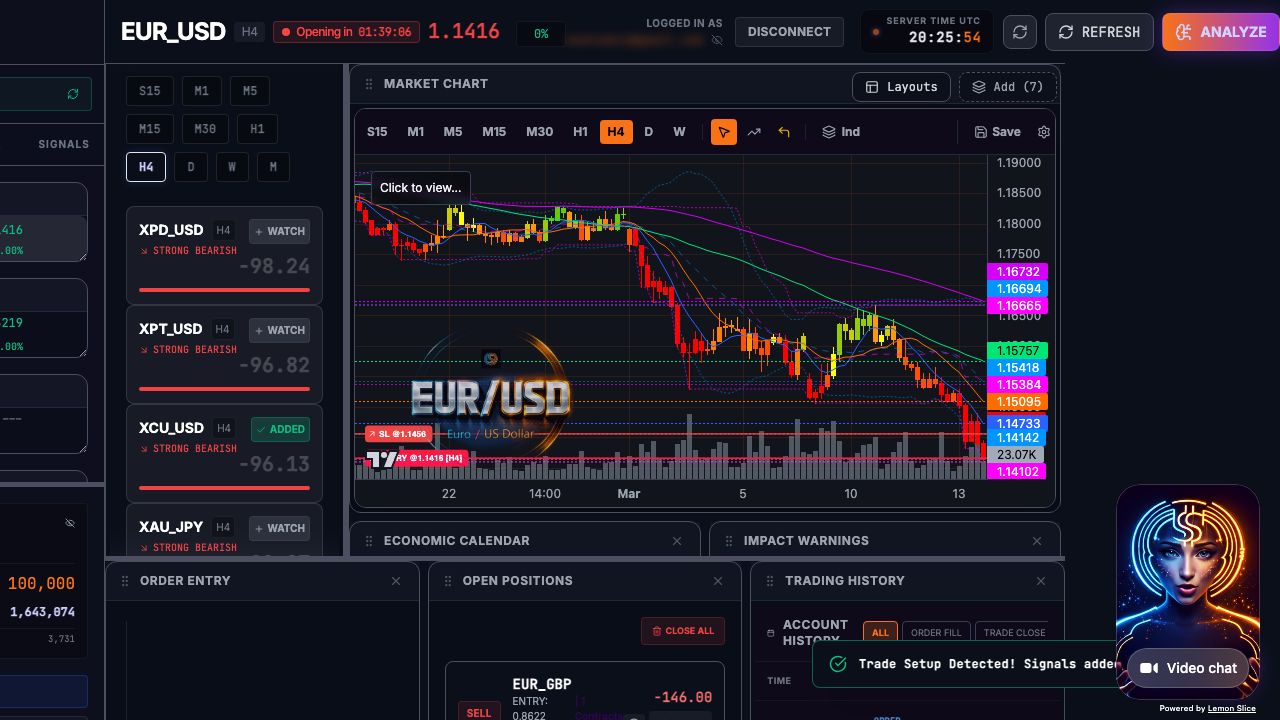
Using Technical Analysis AI Effectively
Technical analysis AI is a tool to enhance your analysis, not replace it.
The Analysis Workflow
- Trigger scan: "Analyze EUR/USD"
- Review AI analysis: Check AI's interpretation
- Verify with chart: Open interactive chart for visual confirmation
- Check multiple timeframes: Ensure alignment
- Make decision: Trade only if AI and manual analysis align
Interpreting AI Signals
AI signals include:
- Direction: Bullish/bearish/neutral
- Strength: How strongly the data supports the signal
- Sentiment Score: The -100 to +100 technical score
- Supporting indicators: Which indicators drove the signal
Combining with Other Analysis
- Sentiment analysis: Does AI sentiment support the technical signal?
- Fundamental context: Are there upcoming news events?
- Risk management: Apply your risk rules regardless of AI signal
Limitations of Technical Analysis AI
AI technical analysis has powerful capabilities but important limitations.
What AI Cannot Do
- Predict the future: AI identifies patterns, not certainties
- Account for black swan events: Unexpected news events
- Understand fundamentals: AI doesn't interpret economic data
- Replace human judgment: AI provides data, you make decisions
Market Structure Changes
AI models trained on historical data may not perform well during:
- Regime shifts: Changes in market behavior
- New instruments: Fresh assets with no history
- Unusual volatility: Market anomalies and flash events
The Human-in-the-Loop Approach
Effective analysis combines AI with human judgment. Learn more in our chart analysis AI guide, the forex analysis software overview, and the AI trading assistant page:
- AI processes data: Rapid analysis of indicators
- Human review: Apply context and judgment
- Risk assessment: Apply your risk management rules
- Trade decision: You approve or reject
FAQ
How many technical indicators does ForexGPT provide?
ForexGPT provides access to 20+ technical indicators including RSI, MACD, SMAs (7/14/50/100), Bollinger Bands, Stochastic, ATR, ADX, Donchian Channels, Fibonacci levels, Parabolic SAR, Ichimoku, Keltner Channels, CCI, Williams %R, Awesome Oscillator, Momentum, and more.
Can AI identify chart patterns?
ForexGPT's AI can identify candlestick patterns, chart patterns (head and shoulders, double top/bottom, triangles), and continuation patterns (flags, pennants, wedges) as part of its broader technical analysis. Pattern recognition is not a standalone tool with separate confidence measures.
What timeframes does AI analyze?
ForexGPT analyzes 5+ timeframes simultaneously: daily, 4-hour, 1-hour, 30-minute, and 15-minute charts. The AI assesses alignment across timeframes for stronger signals.
How accurate is AI technical analysis?
AI technical analysis provides Sentiment Scores (-100 to +100) based on technical context. It identifies setups with strong scores when multiple indicators align. However, accuracy varies by market conditions—no AI system can predict with certainty.
Can I customize the technical indicators?
Yes. The Pro tier allows you to customize indicator settings, add custom configurations, and save your preferred indicator setups for recurring analysis.
Does ForexGPT analyze crypto and commodities?
Yes. The technical analysis tools work for all 127+ supported assets including forex pairs, crypto pairs, stock indices, and commodities. The AI adjusts indicator weightings based on asset-specific characteristics.
About the Author
This article was written by the ForexGPT team, led by Steven Hatzakis—a financial services industry expert with over 20 years of experience in forex and fintech. For a deeper look at the platform architecture and methodology, read the ForexGPT White Paper. For his latest research on AI-driven trading systems, see Steven's paper on Protocol-Constrained Agentic Systems. Explore all guides and tools on the Learn resource hub.
This content was created with AI assistance, reviewed for accuracy by the ForexGPT team, and is updated regularly to reflect current platform capabilities.
Important Disclaimer
ForexGPT is a market analysis tool, not a financial advisor. All content on this page is for informational and educational purposes only. It does not constitute investment advice, financial advice, or trading advice.
Trading forex and other financial instruments involves substantial risk of loss and is not suitable for all investors. Past performance of any analysis tool or signal does not guarantee future results. You should carefully consider your investment objectives, level of experience, and risk appetite before trading.
ForexGPT does not guarantee the accuracy, completeness, or timeliness of any analysis or signal generated by its tools. Always conduct your own research and consult with a qualified financial advisor before making trading decisions.
Start Analyzing Technicals - Try ForexGPT Free Today