Forex Trading Signals Software Powered by AI
Forex Trading Signals Software Powered by AI
Forex trading signals software identifies potential buy and sell opportunities based on technical analysis, market sentiment, and historical patterns. These signals provide traders with data-driven recommendations about which currency pairs might move in a particular direction.
It's important to clarify that signals are not guarantees—they are analytical readings based on current market conditions and historical data. Successful traders use signals as starting points for their analysis, not as automatic trading instructions.
As a forex signal platform, ForexGPT combines AI-powered analysis with traditional technical indicators to provide context-rich readings across 127+ assets. Let's explore how this signal software for forex works and how to evaluate signal quality.
What Forex Trading Signal Software Does
Forex trading signal software generates buy/sell indicators by analyzing price action, technical indicators, and market sentiment. A signal typically includes:
- Direction: Whether the software suggests buying (bullish) or selling (bearish) a particular currency pair
- Entry level: The suggested price at which to enter the trade
- Stop-loss level: The price at which to exit if the trade moves against you
- Take-profit level: The target price for closing the trade profitably
These components help traders structure their trades with proper risk management. However, signal quality varies significantly based on the underlying methodology, data freshness, and risk context provided.
How Signal Quality Is Determined
Not all signals are created equal. The quality of forex signal software depends on several factors:
- Data source quality: Real-time data from reputable brokers ensures signals reflect current market conditions
- Methodology transparency: Knowing how signals are generated helps you assess their reliability
- Backtesting transparency: Reputable providers show how their methodology performed historically
- Risk context: Signals should include sentiment strength and potential risk factors
Beware of signal providers that promise "100% accuracy" or "guaranteed profits." The CFTC warns that such claims are often associated with scams. Real signal software acknowledges uncertainty and provides context, not promises.
How ForexGPT Generates Market Analysis Signals
ForexGPT's signal generation follows a systematic pipeline that combines live market data with AI interpretation.
The Signal Generation Pipeline
First, live OANDA market data flows into ForexGPT's analysis system. This data includes real-time OHLC (open, high, low, close) prices and spreads.
Next, technical indicators are calculated for each asset. ForexGPT supports 20+ technical indicators, including SMAs (7, 14, 50, 100), RSI, MACD, Bollinger Bands, Donchian Channels, and Fibonacci levels. These indicators are calculated across multiple timeframes to provide context.
Then, the AI interprets the technical readings. Rather than producing a simple signal, this ai forex signal tool generates a comprehensive analysis that includes:
- Signal direction: Bullish, bearish, or neutral
- Sentiment Score: A normalized technical score from -100 to +100 derived from trend, momentum, and range behavior
- Supporting indicators: Which technical readings are driving the signal
- Risk context: Entry, stop-loss, and take-profit levels
Finally, the signal is presented in an easy-to-interpret format with visual indicators. You can view signals for individual assets, scan multiple assets simultaneously, or filter signals by specific criteria.
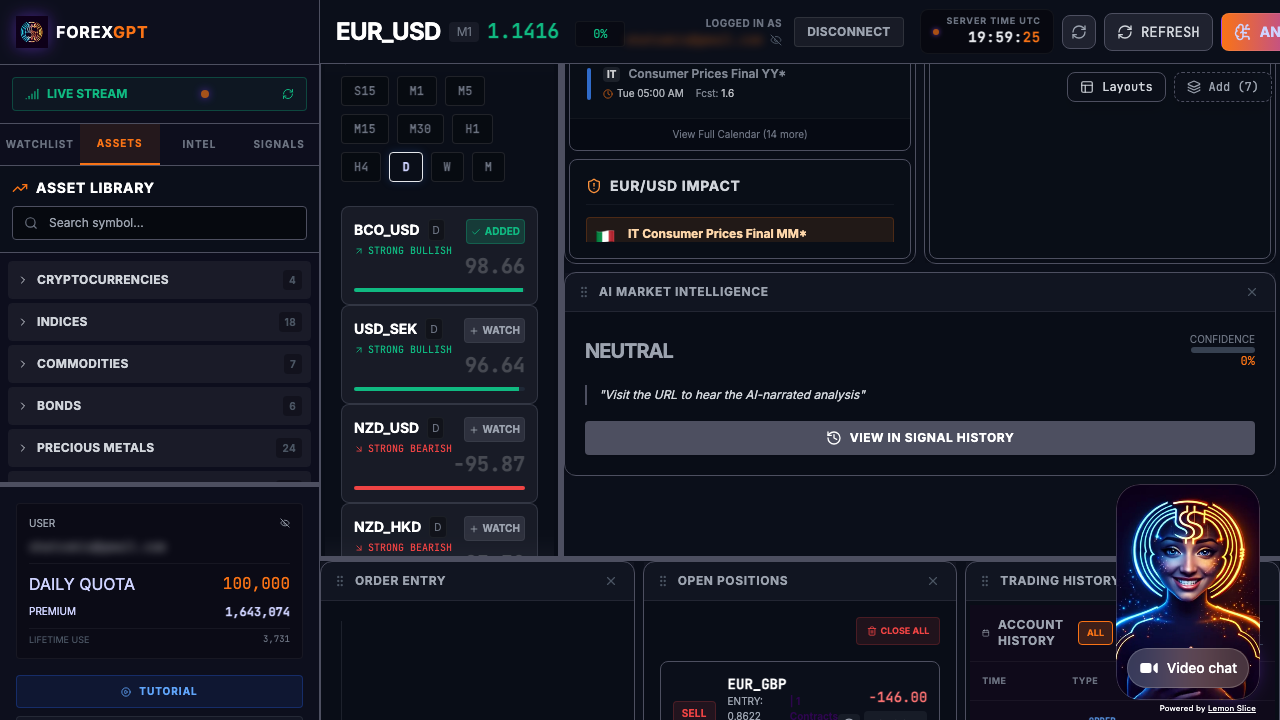
Understanding Signal Output
Each signal includes multiple data points to help you make informed decisions:
- Signal reading: The primary bullish/bearish/neutral indicator
- Strength indicator: Shows how strongly the data supports the signal
- Timeframe context: Signals are generated for multiple timeframes simultaneously
- Historical accuracy: For some tools, historical performance data is available
The key is understanding that signals are probabilistic, not deterministic. Any trading signal analysis software that claims otherwise should be treated with skepticism. A "strong bullish" signal means the current data strongly suggests upward momentum, but it doesn't guarantee that outcome.
How Traders Use ForexGPT: A Step-by-Step Workflow
Before making any trade decision, many professional traders follow a structured analysis workflow. Here's how you would use ForexGPT in practice:
Step 1: Market Scanning (5-10 minutes)
Start your trading day with the Forex Market Scanner:
- Launch the market scanner to view all 127+ supported assets
- Filter by your preferred currency pairs or commodities
- Review the initial bullish/bearish readings and Sentiment Scores
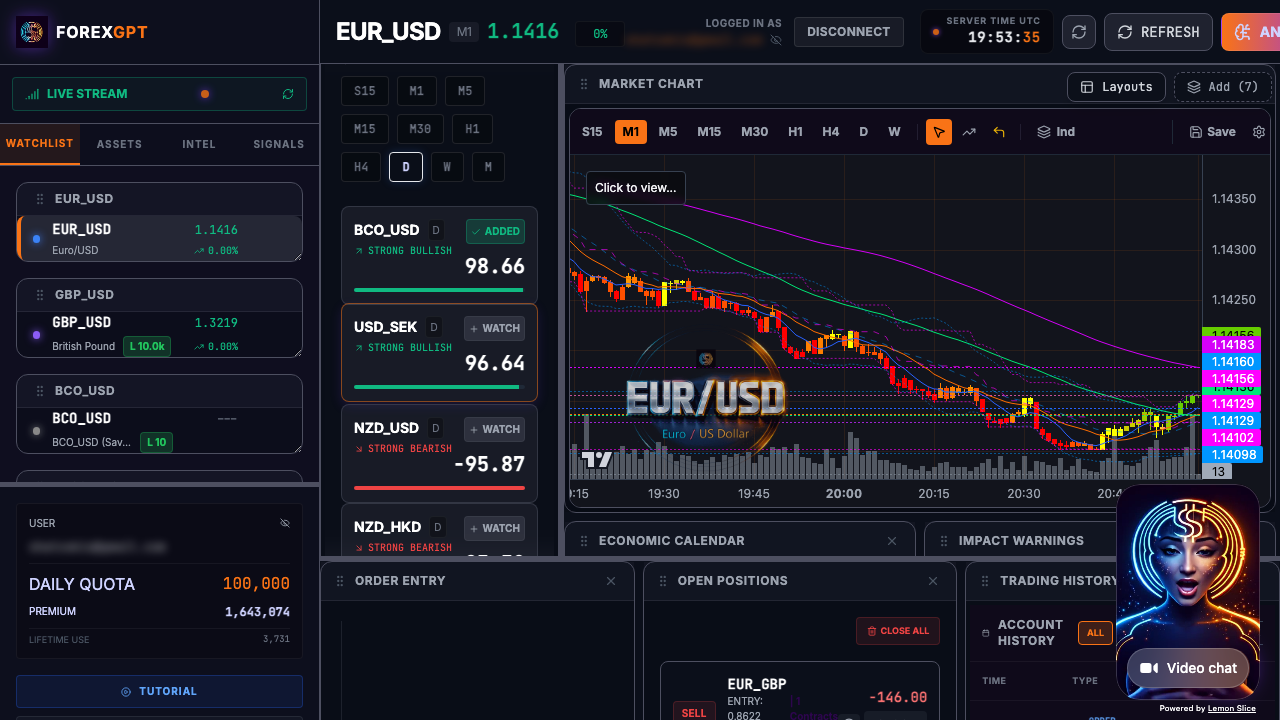
ForexGPT's forex signal generator quickly highlights which assets show the strongest signals, saving you hours of manual analysis.
Step 2: Deep Analysis of High-Potential Assets (10-15 minutes)
Select 3-5 assets with strong signal readings for deeper analysis:
- Use the AI Forex Trading Assistant to analyze each asset
- Review the comprehensive technical breakdown
- Examine sentiment analysis derived from technical context
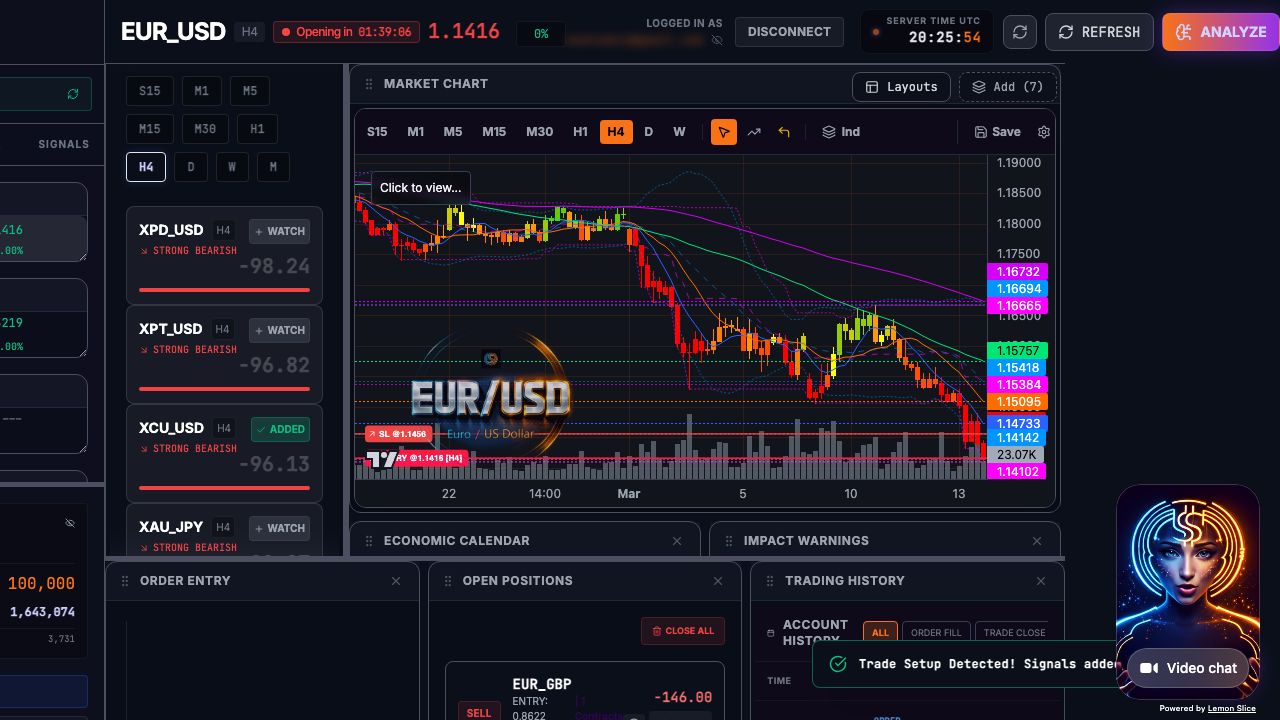
The assistant explains why the signal is being generated, citing specific indicators and market conditions.
Step 3: Multi-Timeframe Validation (5-10 minutes)
Verify your selected signals across multiple timeframes:
- Navigate to the multi-timeframe analysis section
- View signals for daily, 4-hour, 1-hour, and 15-minute charts
- Look for alignment across timeframes for stronger confirmation
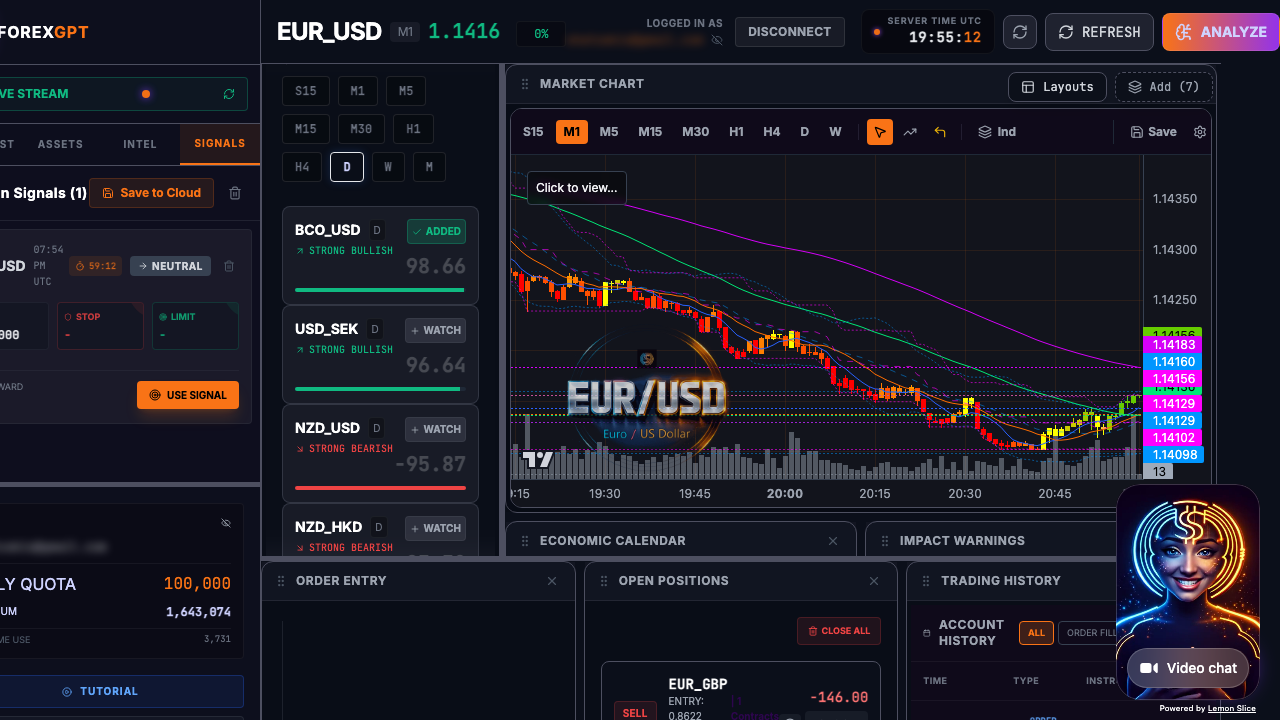
When daily, 4-hour, and 1-hour timeframes all point in the same direction, the signal carries more weight.
Step 4: Risk Assessment (5 minutes)
Before entering any trade, assess your risk parameters:
- Review the Sentiment Score and volatility metrics
- Note the suggested stop-loss and take-profit levels
- Calculate position size based on your account risk (typically 1-2%)
The system provides risk context including:
- Current volatility compared to historical averages
- Sentiment Score indicating signal strength
- Entry, stop-loss, and take-profit levels
Step 5: Trade Execution and Monitoring
With your analysis complete:
- Use your broker's platform to execute the trade at your desired entry
- Set your stop-loss and take-profit levels
- Return to ForexGPT to monitor signal strength throughout the trade
Signals are updated in real-time, so you can adjust your position if market conditions change significantly.
Signal Validation: How to Assess Any Signal Provider
Before trusting any signal provider, you should validate their methodology. Here's a framework for assessing signal quality:
Check the Data Source
Signals based on stale or delayed data are unreliable. ForexGPT uses live OANDA data feeds to ensure signals reflect current market conditions. Check whether your signal provider uses real-time data or delayed feeds.
Understand the Methodology
Reputable signal providers explain how their signals are generated. ForexGPT's methodology combines OHLC data with SMAs (7, 14, 50, 100), Bollinger Bands, and Donchian Channels to produce a Sentiment Score that drives signal generation, similar to the approach used in our sentiment analysis tool. Look for transparency about the specific indicators and weightings used.
Look for Backtesting Transparency
While past performance doesn't guarantee future results, signal providers should be able to show how their methodology has performed historically. ForexGPT provides historical context where relevant, showing how similar market conditions have played out in the past.
Never Trust "100% Win Rate" Claims
The CFTC and NFA have repeatedly warned about signal scams that promise unrealistic performance. If a provider claims a "100% win rate" or guarantees profits, it's a red flag. Real market analysis involves uncertainty and risk.
Evaluate the Risk Context
Quality signal software includes risk context: volatility levels, Sentiment Scores, and entry/stop-loss/take-profit levels. ForexGPT's analysis always includes risk information alongside signal readings.
Multi-Timeframe Analysis for Better Signal Context
Using signals from a single timeframe can be misleading. ForexGPT's multi-timeframe analysis provides a more complete picture of market conditions.
Why Single-Timeframe Signals Are Risky
A signal that appears bullish on a 15-minute chart might be part of a larger bearish trend on the daily chart. Trading based on a single timeframe without considering the broader context can lead to poor decisions.
How Multi-Timeframe Analysis Helps
ForexGPT's analyze_timeframes tool generates signals across multiple timeframes simultaneously:
- Daily chart: Shows the primary trend direction
- 4-hour chart: Identifies intermediate-term momentum
- 1-hour chart: Reveals short-term entry opportunities
- 15-minute chart: Shows immediate price action
When all timeframes align (e.g., bullish on daily, 4-hour, and 1-hour), the signal carries more weight. When timeframes conflict, it signals caution and the need for deeper analysis.
Using Timeframe Alignment to Filter Signals
A practical approach to multi-timeframe signal analysis:
- Start with the daily chart to identify the primary trend
- Move to the 4-hour chart to confirm the intermediate trend
- Check the 1-hour chart for entry timing
- Use the 15-minute chart for precise entry/exit levels
Signals that align across multiple timeframes tend to be more reliable than those based on a single timeframe.
Free Signals vs Pro Analysis
ForexGPT provides free signal-like analysis alongside comprehensive Pro-tier capabilities.
Free Signal Capabilities
The free tier includes access to 8 tools with a daily 57,000 free token allowance, including scan_market, which ranks assets by Sentiment Score. This tool provides:
- Bullish/bearish/neutral readings for each asset
- Sentiment Scores (-100 to +100) indicating signal strength
- Supporting technical indicators
Pro Signal Capabilities
The Pro tier adds:
- Deep analysis with sentiment scoring
- Multi-timeframe alignment analysis
- Custom watchlist signal tracking
- Trade execution integration with OANDA
- Historical signal performance data
- Voice-controlled signal analysis
The free tier gives you a solid foundation for signal analysis. The Pro tier enhances this with additional context and tools for more sophisticated trading workflows, including the heatmap screener and AI-generated forex signals with deeper Sentiment Score analysis.
FAQ
How accurate are ForexGPT signals?
ForexGPT's signal readings are based on technical analysis across 20+ technical indicators. The accuracy of signals depends on market conditions, volatility, and the specific asset being analyzed. Each signal includes a Sentiment Score (-100 to +100) that indicates how strongly the technical data supports the reading—scores near the extremes represent stronger signals, while scores near 0 indicate neutral conditions. However, no signal software can guarantee accuracy, as market conditions can change rapidly. Even strong signals should be used as part of a broader trading strategy.
What data sources does ForexGPT use?
ForexGPT uses live OANDA market data feeds to ensure signals reflect current market conditions. This includes real-time OHLC prices and spreads. The Sentiment Score is derived entirely from technical context—trend, momentum, and range behavior across core indicators (price position vs Bollinger Bands, SMAs 7/14/50/100, Donchian Channels). It is not derived from news, social media, or retail positioning. All data is updated in real-time with minimal latency.
How often are signals updated?
Signals are updated in real-time as market data flows into the system. During active market hours (24 hours Sunday to 5pm Friday EST), signals refresh continuously as price movements trigger new analysis. The scan_market tool provides up-to-date readings for all 127+ supported assets. For less liquid assets or during quieter market periods, update frequency may vary based on significant price movements.
Can I rely on signals alone for trading?
Signals should be one component of your trading strategy, not the sole basis for decisions. Successful trading requires:
- Risk management: Always use stop-loss orders and position sizing
- Market context: Consider economic news, geopolitical events, and market sentiment
- Technical analysis: Verify signals with your own chart analysis
- Fundamental analysis: Understand the broader economic picture
Think of ForexGPT signals as intelligent starting points that highlight potential opportunities, not as definitive buy/sell commands.
What's the difference between signals and trading bots?
Signals provide analysis and recommendations—you make the final trading decisions. Trading bots execute trades automatically based on programmed rules. ForexGPT is a signal and analysis platform, not an automated trading bot. This approach gives you more control while still providing valuable market insights. If you prefer automation, our Pro tier includes integration options that allow you to execute signals directly through your OANDA account.
How do I use multi-timeframe analysis effectively?
Multi-timeframe analysis works by identifying the dominant trend on higher timeframes (daily, 4-hour) and then timing entries on lower timeframes (1-hour, 15-minute). Here's a practical approach:
- Daily chart: Determine the primary trend (bullish/bearish/neutral)
- 4-hour chart: Confirm intermediate momentum and identify support/resistance
- 1-hour chart: Look for entry signals within the dominant trend
- 15-minute chart: Fine-tune your entry/exit points
A signal becomes more reliable when all timeframes align. If the daily chart shows bullish sentiment but the 15-minute chart shows oversold conditions, you might wait for a pullback before entering.
What is sentiment analysis and how does it affect signals?
Sentiment analysis in ForexGPT measures market mood by analyzing technical context—trend, momentum, and range behavior across core indicators including price position vs Bollinger Bands, SMAs (7, 14, 50, 100), and Donchian Channels. The resulting Sentiment Score (-100 to +100) indicates whether an asset is technically bullish, bearish, or neutral. The score is incorporated directly into signal generation: OHLC data plus these core indicators produce the Sentiment Score, which then drives the signal direction (bullish/bearish/neutral) along with entry, stop-loss, and take-profit levels.
How do I interpret Sentiment Scores?
The Sentiment Score (-100 to +100) indicates how strongly the technical data supports a signal reading:
- Weak (near 0): Mixed signals, neutral conditions, or conflicting indicators
- Moderate (±30 to ±60): Clear direction but not extreme
- Strong (±60 to ±80): Consistent signals across multiple indicators
- Very Strong (±80 to ±100): High conviction signal with strong technical alignment
A strong score doesn't mean the signal will succeed—markets always involve uncertainty. Rather, Sentiment Scores help you prioritize which signals merit closer attention and potentially larger position sizes within your risk parameters.
About the Author
This article was written by the ForexGPT team, led by Steven Hatzakis—a financial services industry expert with over 20 years of experience in forex and fintech. For a deeper look at the platform architecture and methodology, read the ForexGPT White Paper. For his latest research on AI-driven trading systems, see Steven's paper on Protocol-Constrained Agentic Systems. Explore all guides and tools on the Learn resource hub.
This content was created with AI assistance, reviewed for accuracy by the ForexGPT team, and is updated regularly to reflect current platform capabilities.
Important Disclaimer
ForexGPT is a market analysis tool, not a financial advisor. All content on this page is for informational and educational purposes only. It does not constitute investment advice, financial advice, or trading advice.
Trading forex and other financial instruments involves substantial risk of loss and is not suitable for all investors. Past performance of any analysis tool or signal does not guarantee future results. You should carefully consider your investment objectives, level of experience, and risk appetite before trading.
ForexGPT does not guarantee the accuracy, completeness, or timeliness of any analysis or signal generated by its tools. Always conduct your own research and consult with a qualified financial advisor before making trading decisions.
Start Analyzing Signals Today - Try ForexGPT Free and Upgrade to Pro for Advanced Signal Analysis