Forex Sentiment Score: How AI Measures Market Mood
Forex Sentiment Score: How AI Measures Market Mood
Market sentiment, often called "market mood" or forex mood indicator, reflects the collective psychology of traders toward a particular currency pair or the broader market. It's a measure of whether participants are optimistic (bullish) or pessimistic (bearish) at any given moment.
An ai sentiment score forex quantifies this collective mood into a single, actionable number. This currency sentiment score provides a quick read on market positioning. When combined with technical analysis, sentiment scores provide context for interpreting price action and identifying potential reversals or continuations.
ForexGPT's AI-powered market sentiment scoring system analyzes 127+ assets to produce these scores. For a deeper dive into the methodology, see our sentiment analysis tool page and the guide to how forex sentiment analysis works. Let's explore how sentiment is measured, interpreted, and used effectively in trading analysis.
Understanding Sentiment Scoring
A sentiment score is a numerical representation of market mood, typically ranging from -100 (extremely bearish) to +100 (extremely bullish), with 0 as neutral.
The Sentiment Score Range
- -100 to -70: Extremely bearish (oversold conditions possible)
- -70 to -30: Bearish (dovish market sentiment)
- -30 to +30: Neutral (balanced buying and selling)
- +30 to +70: Bullish (bullish market sentiment)
- +70 to +100: Extremely bullish (overbought conditions possible)
These ranges are guidelines—extreme readings don't guarantee reversals, they indicate potential exhaustion in the current trend.
What the Score Represents
The sentiment score is a normalized technical score derived from technical context — trend, momentum, and range behavior across core indicators:
- Price position vs Bollinger Bands: Upper, middle, and lower band relationships
- Simple Moving Averages (SMAs 7/14/50/100): Price position relative to key SMAs
- Donchian Channels: Upper, middle, and lower channel positioning
The AI synthesizes these technical inputs into a single normalized score.
How ForexGPT's Sentiment Scoring Works
ForexGPT's AI sentiment scoring combines multiple analytical approaches.
Technical Data Sources for Sentiment Scoring
The Sentiment Score is derived entirely from technical context using OHLC data from OANDA:
OHLC Candle Data: The last candle's open, high, low, and close values form the foundation of the score calculation.
Simple Moving Averages (SMAs 7/14/50/100): Price position relative to these four key SMAs indicates trend direction and strength. Price above key SMAs indicates bullish sentiment; price below indicates bearish sentiment.
Bollinger Bands: Upper, middle, and lower band relationships reveal volatility context and price positioning within the current range.
Donchian Channels: Upper, middle, and lower channel levels provide range behavior context, identifying breakouts and range-bound conditions.
The Scoring Algorithm
The AI processes these technical inputs through a normalization algorithm:
- Ingest OHLC data: Pull the last candle's data from OANDA
- Calculate indicators: Compute SMAs (7/14/50/100), Bollinger Bands, and Donchian Channels
- Assess technical context: Evaluate trend, momentum, and range behavior
- Normalize to score: Convert the technical assessment into a score from -100 to +100
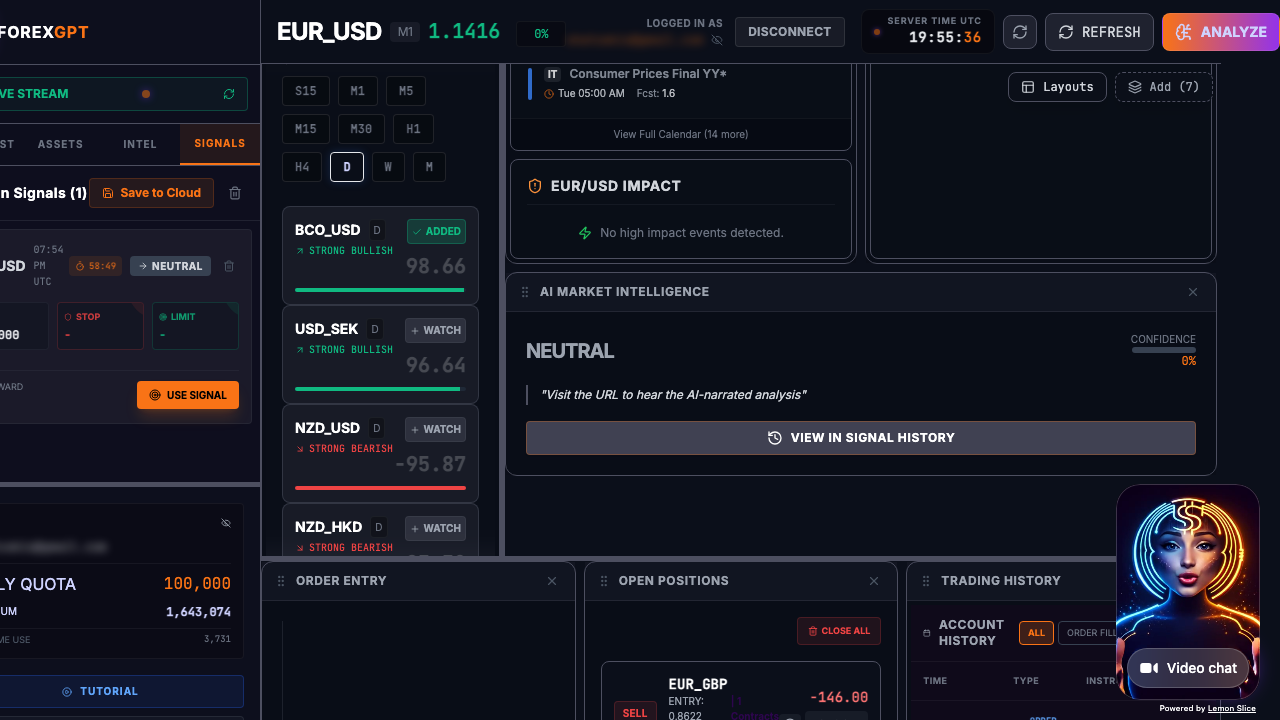
The Sentiment Score itself (-100 to +100) is the measure of signal strength. A score near the extremes indicates strong technical alignment, while scores near zero indicate mixed or neutral technical conditions.
Interpreting Sentiment Scores
Knowing how to interpret sentiment scores is crucial for effective use.
High vs Low Sentiment Readings
High sentiment (positive score):
- More traders are positioned for upside
- May indicate overbought conditions
- Risk of reversal if sentiment becomes extreme
Low sentiment (negative score):
- More traders are positioned for downside
- May indicate oversold conditions
- Risk of reversal if sentiment becomes extreme
Context Matters More Than the Number
A sentiment score should never be interpreted in isolation. Always consider:
- The trend: Sentiment in a strong trend differs from range-bound markets
- Recent changes: A shift from neutral to bullish is significant
- Market conditions: Volatility and range behavior affect interpretation
- Asset-specific factors: Crypto sentiment differs from forex sentiment
Combining with Technical Analysis
The most effective analysis combines sentiment with technicals:
- Bullish sentiment + breakout above resistance: Strong confirmation
- Bearish sentiment + breakdown below support: Strong confirmation
- Conflicting signals: Require deeper analysis before acting
Sentiment Score Ranges and Interpretation
Different score ranges have different implications for trading.
Neutral Zone (±10 to ±30)
- Interpretation: Balanced buying and selling pressure
- Trading implication: Range-bound or consolidation period
- Action: Wait for clearer signals before trading
Moderate Sentiment (±30 to ±60)
- Interpretation: Clear but not extreme market bias
- Trading implication: Trend is likely to continue
- Action: Trade with the trend, confirm with technicals
Strong Sentiment (±60 to ±80)
- Interpretation: Powerful market bias
- Trading implication: Trend likely to continue, but potential exhaustion
- Action: Look for continuation patterns or early reversal signals
Extreme Sentiment (±80 to ±100)
- Interpretation: Potential overbought (positive) or oversold (negative)
- Trading implication: Reversal risk increases, but can persist in strong trends
- Action: Look for confirmation before taking contrarian positions
Combining Sentiment with Technical Analysis
The synergy between sentiment and technical analysis is where ForexGPT adds the most value.
Using Sentiment as a Filter
Before acting on a technical signal:
- Identify the technical setup: Use the market scanner to find setups
- Check sentiment: Does sentiment support the expected direction?
- Look for alignment: Are technicals and sentiment aligned?
- Execute or wait: Trade if aligned, wait if conflicting
Technical Confirmation Examples
- Bullish pattern + positive sentiment: Higher probability long setup
- Bearish pattern + negative sentiment: Higher probability short setup
- Bullish pattern + negative sentiment: Potential trap; wait for confirmation
- Bearish pattern + positive sentiment: Potential trap; wait for confirmation
Signal Strength via Sentiment Score
ForexGPT's Sentiment Score (-100 to +100) itself serves as the signal strength metric:
- Score magnitude: Higher absolute values indicate stronger technical alignment
- Timeframe alignment: Agreement across multiple timeframes strengthens the signal
- Score direction: Positive scores support bullish setups; negative scores support bearish setups
Using Sentiment for Reversal Detection
Sentiment extremes can signal potential reversals when combined with technical confirmation.
Extreme Score Readings
When the Sentiment Score reaches extreme levels (near +100 or -100), it indicates strong technical alignment in one direction, which can precede exhaustion:
- Overextension: Price stretched far from mean levels
- Technical exhaustion: Momentum indicators at extremes
- Reversal potential: Strong readings in one direction may precede pullbacks
Signs of Reversal
Combine extreme Sentiment Scores with:
- Technical divergence: Price makes new high but RSI doesn't
- Candlestick reversal patterns: Engulfing, hammer, shooting star
- Support/resistance levels: Price approaching key levels
- Bollinger Band extremes: Price at or beyond the outer bands
Caution: Trends Can Persist
Extreme sentiment doesn't guarantee an immediate reversal. Strong trends can sustain with extreme sentiment for extended periods.
The key is to look for:
- Extreme Sentiment Score (±80+)
- Technical reversal signals
- Confirmation across multiple timeframes
Common Sentiment Score Traps
Even experienced traders misinterpret sentiment scores. Avoid these pitfalls.
Trap 1: Taking Scores at Face Value
A high Sentiment Score indicates strong technical alignment, but strong trends can persist or reverse without warning.
Solution: Always combine the Sentiment Score with additional technical analysis across multiple timeframes.
Trap 2: Ignoring the Trend
Trading against the daily trend based on sentiment can be risky.
Solution: Use sentiment to fine-tune entries within the trend direction, not to fight the primary trend.
Trap 3: Overvaluing Sentiment Alone
Sentiment is one tool among many. Never use it as the sole basis for trading decisions.
Solution: Always combine sentiment with technical analysis and proper risk management.
Trap 4: Expecting Immediate Reversals
Extreme sentiment doesn't mean a reversal happens immediately. Trends can persist.
Solution: Use extreme sentiment as a warning, not a trigger. Wait for technical confirmation.
FAQ
What is a forex sentiment score?
A forex sentiment score is a number (typically -100 to +100) that quantifies whether market participants are bullish or bearish about a currency pair. Higher scores indicate more bullish sentiment; lower scores indicate more bearish sentiment.
How is the sentiment score calculated?
The score is derived from technical context — trend, momentum, and range behavior across core indicators. It uses OHLC candle data from OANDA along with SMAs (7/14/50/100), Bollinger Bands, and Donchian Channels to produce a normalized technical score from -100 to +100.
What does a neutral sentiment score mean?
A neutral score (±10 to ±30) indicates balanced buying and selling pressure. There's no strong bias in either direction, often indicating a consolidation or range-bound period.
Can sentiment scores predict reversals?
Extreme sentiment scores (±80+) combined with technical reversal signals increase the probability of a reversal. However, trends can persist with extreme sentiment, so always wait for confirmation.
How often is the sentiment score updated?
Sentiment scores update in real-time as market data flows into the system. You can check the score for any asset at any time through the interface.
Does sentiment work for all asset classes?
Yes. ForexGPT's sentiment scoring works for forex pairs, crypto pairs, stock indices, and commodities. The AI adjusts the weightings based on asset-specific data availability.
About the Author
This article was written by the ForexGPT team, led by Steven Hatzakis—a financial services industry expert with over 20 years of experience in forex and fintech. For a deeper look at the platform architecture and methodology, read the ForexGPT White Paper. For his latest research on AI-driven trading systems, see Steven's paper on Protocol-Constrained Agentic Systems. Explore all guides and tools on the Learn resource hub.
This content was created with AI assistance, reviewed for accuracy by the ForexGPT team, and is updated regularly to reflect current platform capabilities.
Important Disclaimer
ForexGPT is a market analysis tool, not a financial advisor. All content on this page is for informational and educational purposes only. It does not constitute investment advice, financial advice, or trading advice.
Trading forex and other financial instruments involves substantial risk of loss and is not suitable for all investors. Past performance of any analysis tool or signal does not guarantee future results. You should carefully consider your investment objectives, level of experience, and risk appetite before trading.
ForexGPT does not guarantee the accuracy, completeness, or timeliness of any analysis or signal generated by its tools. Always conduct your own research and consult with a qualified financial advisor before making trading decisions.
Start Analyzing Sentiment - Try ForexGPT Free Today