Forex Sentiment Analysis Tool for Currency Traders
Forex Sentiment Analysis Tool for Currency Traders
Market sentiment refers to the overall attitude of traders toward a particular currency pair or the forex market as a whole. It measures whether market participants are bullish (optimistic) or bearish (pessimistic), which influences price movements.
A forex sentiment analysis tool—sometimes called a market sentiment forex tool—helps you understand this collective market mood by analyzing technical context: trend, momentum, and range behavior across core indicators. When used alongside your own analysis, sentiment data provides additional context for identifying potential reversals, confirming trends, and timing entries.
ForexGPT's ai sentiment forex tool provides AI-powered sentiment scoring for 127+ forex, crypto, index, and commodity instruments. Let's explore how sentiment analysis works and how to interpret it effectively.
What Forex Sentiment Analysis Measures
ForexGPT's sentiment analysis measures the technical posture of an asset—whether price action, trend, and momentum indicators point bullish, bearish, or neutral.
How ForexGPT Derives Sentiment
ForexGPT's Sentiment Score is derived from technical context, specifically:
- Price position vs Bollinger Bands: Whether price is near the upper, middle, or lower band
- SMA alignment (7, 14, 50, 100): How price relates to short- and long-term moving averages
- Donchian Channels: Whether price is near the upper, middle, or lower channel boundary
- Trend and momentum behavior: The overall directional bias from these core indicators
The score is normalized into a range of -100 to +100. It is not derived from news, social media, retail positioning, or order flow.
How Sentiment Complements Other Analysis
Technical indicators tell you what the market is doing at a granular level. The Sentiment Score provides a normalized summary—whether the overall technical picture leans bullish, bearish, or neutral, and how strongly.
Why Traders Use Both Together
Combining sentiment with technical analysis provides a more complete picture:
- Confirmation: Technical signals are more reliable when sentiment supports them
- Early warning: Contrarian readings from a currency sentiment analysis can signal potential reversals before technical indicators shift
- Context: Sentiment helps you understand whether a technical pattern is likely to succeed
For example, a bullish technical pattern in a market with extreme bearish sentiment may signal a strong reversal opportunity.
How ForexGPT's Sentiment Scoring Works
ForexGPT's sentiment scoring system provides a comprehensive view of market mood across 127+ assets. Let's break down how the scoring works.
The Sentiment Scoring Methodology
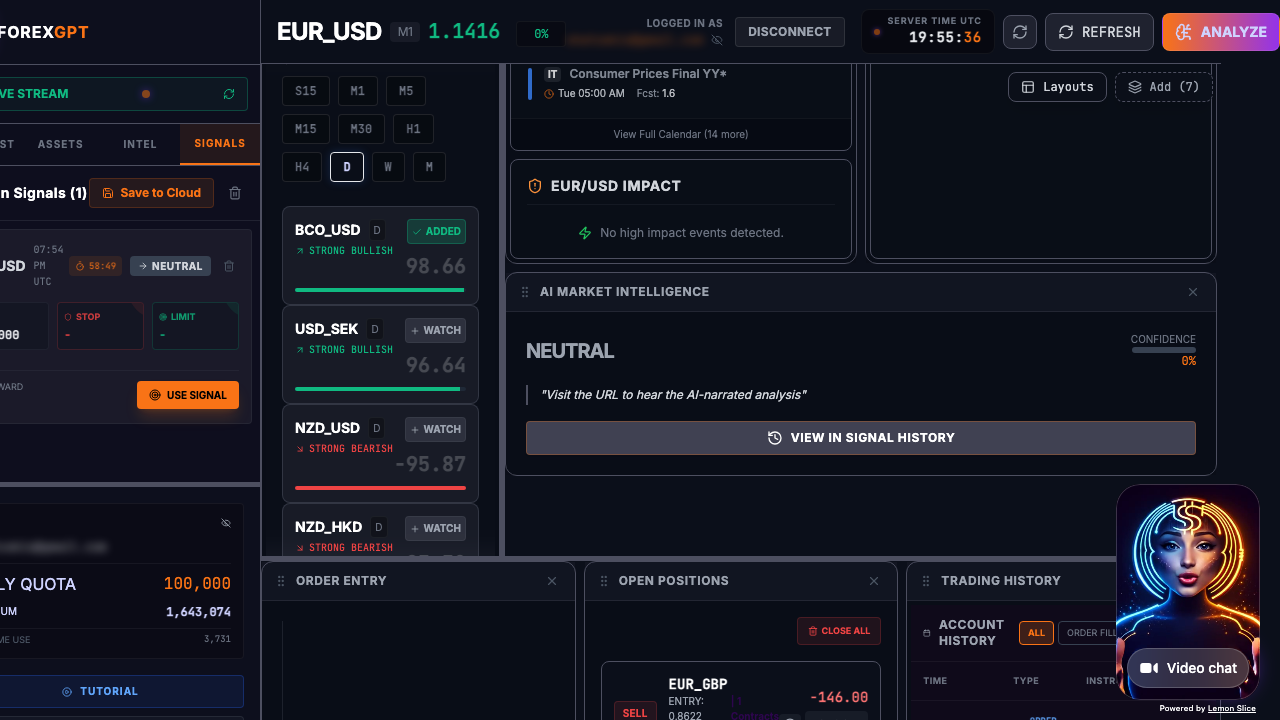
The forex sentiment score ranges from -100 (extremely bearish) to +100 (extremely bullish), with 0 representing neutral sentiment. The score is calculated from the OHLC of the last candle combined with core technical indicators:
- SMAs (7, 14, 50, 100): How price relates to short-term and long-term moving averages
- Bollinger Bands (upper, middle, lower): Price position within the volatility envelope
- Donchian Channels (upper, middle, lower): Price position within the recent range
These inputs are normalized into a single Sentiment Score that reflects the overall technical posture of the asset.
What the Score Represents
A positive Sentiment Score indicates bullish technical conditions (e.g., price above key SMAs, near upper Bollinger Band), while a negative score indicates bearish technical conditions. A score near 0 generates a neutral signal. The Sentiment Score itself is the measure of signal strength—no separate confidence percentage is produced.
Interpreting Sentiment Readings
Sentiment readings should be interpreted with context:
- Extreme readings (±80+): Suggest the market may be overbought or oversold, potentially setting up for a reversal
- Moderate readings (±30 to ±60): Indicate a clear but not extreme market bias
- Neutral readings (±10 to -10): Suggest balanced buying and selling pressure
Remember that sentiment extremes don't cause reversals—they often persist during strong trends. A reliable forex sentiment indicator highlights extremes, but the key is to look for those extremes combined with technical confirmation of potential reversal patterns.
How Traders Use Sentiment Analysis: A Practical Workflow
Sentiment analysis is most powerful when integrated into your existing trading process. Here's a step-by-step look at how professional traders use ForexGPT's sentiment tools.
Pre-Trade Analysis: Checking Sentiment Before Entry
Identify a potential setup using your preferred technical analysis method or the AI forex trading assistant
- Look for key support/resistance levels
- Identify chart patterns (head and shoulders, triangles, etc.)
- Check for technical indicator signals (RSI oversold/overbought, MACD crossovers)
Check sentiment context using ForexGPT before entering the trade
- Access the sentiment dashboard for your asset
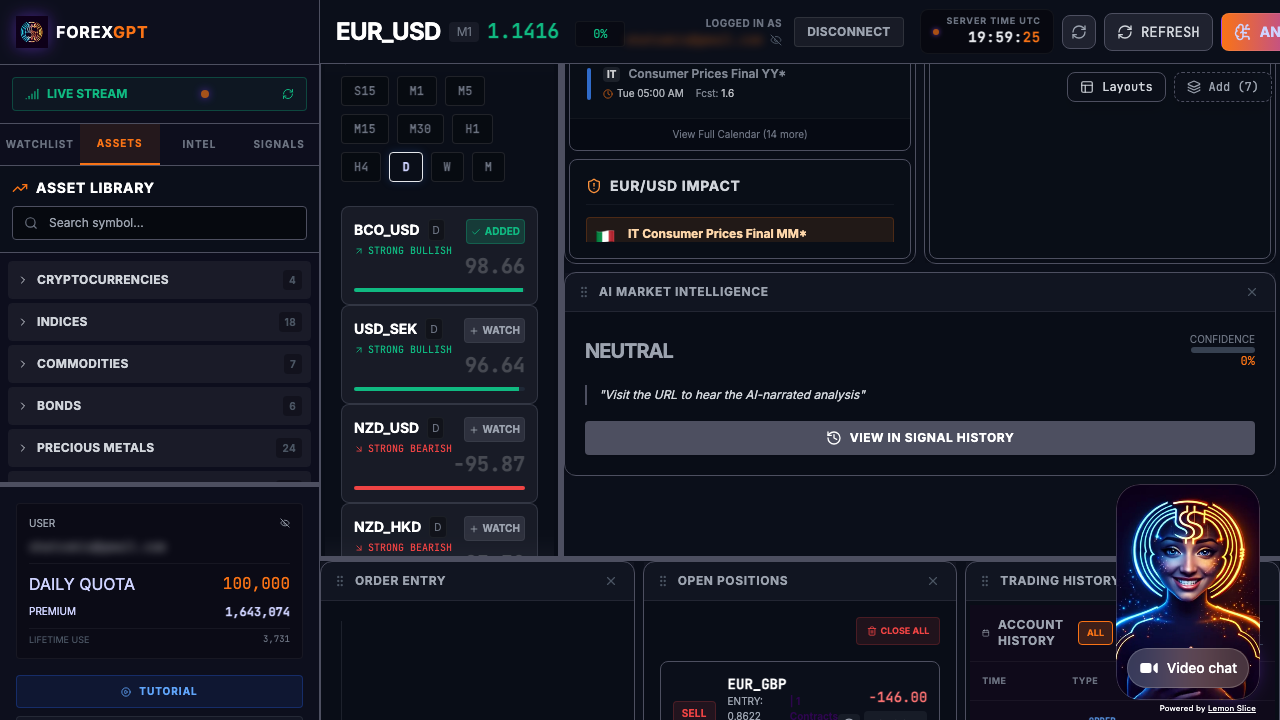
- Review the current sentiment score and trend
- Look at how far the score is from 0 to assess signal strength
- Check the breakdown to understand what's driving the sentiment
Align sentiment with your analysis
- Bullish technical setup + bullish/neutral sentiment = strong confirmation
- Bullish technical setup + extreme bearish sentiment = potential contrarian opportunity (or wait for sentiment shift)
- Bearish technical setup + bearish sentiment = strong confirmation
- Bearish technical setup + bullish sentiment = caution, potential false breakdown
Set your trade parameters
- Entry: Adjust based on sentiment alignment
- Stop-loss: Place below support (long) or above resistance (short)
- Take-profit: Set based on your risk/reward ratio
Monitor sentiment during the trade
- Sentiment Scores can shift quickly as technical conditions change
- Use ForexGPT's tools to track Sentiment Score changes
- Consider adjusting position size if sentiment moves against you
Example: EUR/USD Trade with Sentiment Confirmation
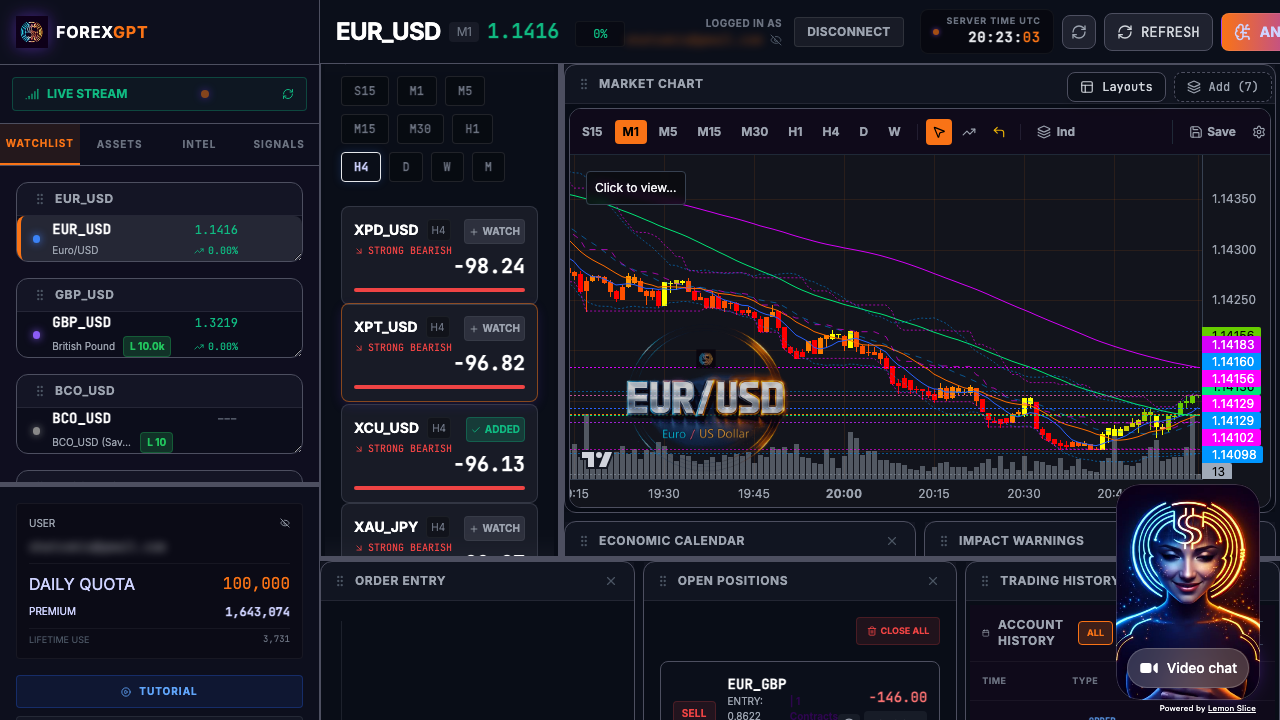
- Technical analysis shows price bouncing off a key support level with a bullish divergence on RSI
- ForexGPT shows a Sentiment Score of +25 (moderately bullish)
- Sentiment has been gradually increasing over the past 24 hours
- You enter a long position with confidence that sentiment supports the technical setup
- Later, the Sentiment Score drops to -15 as technical conditions shift
- You adjust your stop-loss to breakeven and consider reducing position size
Using Sentiment for Contrarian Trading
Extreme sentiment readings can indicate contrarian opportunities:
- Identify extremes: Look for sentiment scores above +70 or below -70
- Check for technical confirmation: Wait for signs of exhaustion (divergences, reversal patterns)
- Verify with multiple timeframes: Ensure higher timeframe sentiment is also extreme
- Enter with proper risk management: Place stop-loss beyond recent swing points
- Target retracement levels: Aim for sentiment to return to neutral (+/-30 range)
Common Sentiment Analysis Traps
Even experienced traders can fall into traps when interpreting sentiment data. Here are the most common mistakes and how to avoid them.
Trap 1: Following the Crowd
Sentiment extremes don't always mean a reversal is imminent. In a strong trend, sentiment can remain extreme for extended periods.
The key is understanding the broader technical context. Look at:
- Trend strength: Is the asset in a well-established trend supported by SMA alignment?
- Range behavior: Is price near the extremes of Bollinger Bands and Donchian Channels?
- Market phase: Sentiment works differently in trending vs. range-bound markets
Trap 2: Ignoring Context
A sentiment score in isolation doesn't tell you much. Always consider:
- The asset's current trend: Sentiment in a strong trend differs from sentiment in a range-bound market
- Recent changes: A shift from neutral to bearish is more significant than a static bearish score
- Market conditions: Sentiment interpretation differs during news events, volatility spikes, and normal trading conditions
- Timeframe: Daily sentiment differs from weekly or intraday sentiment
Trap 3: Overvaluing Sentiment
Sentiment is one piece of the puzzle, not the entire analysis. Never use sentiment alone to make trading decisions. Always combine it with:
- Technical analysis: Price patterns and indicators
- Fundamental analysis: Economic data, central bank policy, geopolitical events
- Risk management: Proper position sizing, stop-loss placement, risk/reward ratios
Trap 4: Trusting the Score Without Context
The Sentiment Score is a normalized technical summary. If you don't understand what drives the score, it's easy to misinterpret it.
ForexGPT's interface provides the breakdown of what's driving each Sentiment Score, so you can understand the reasoning behind the number. Key factors include:
- SMA positioning: Price relative to SMAs 7, 14, 50, and 100
- Bollinger Band position: Where price sits within the upper, middle, and lower bands
- Donchian Channel position: Where price sits within the recent range
- Overall trend and momentum: The directional bias from these combined indicators
Sentiment Across Asset Classes
Sentiment analysis works differently across different asset classes, and ForexGPT's scoring system accounts for these differences.
Forex Majors
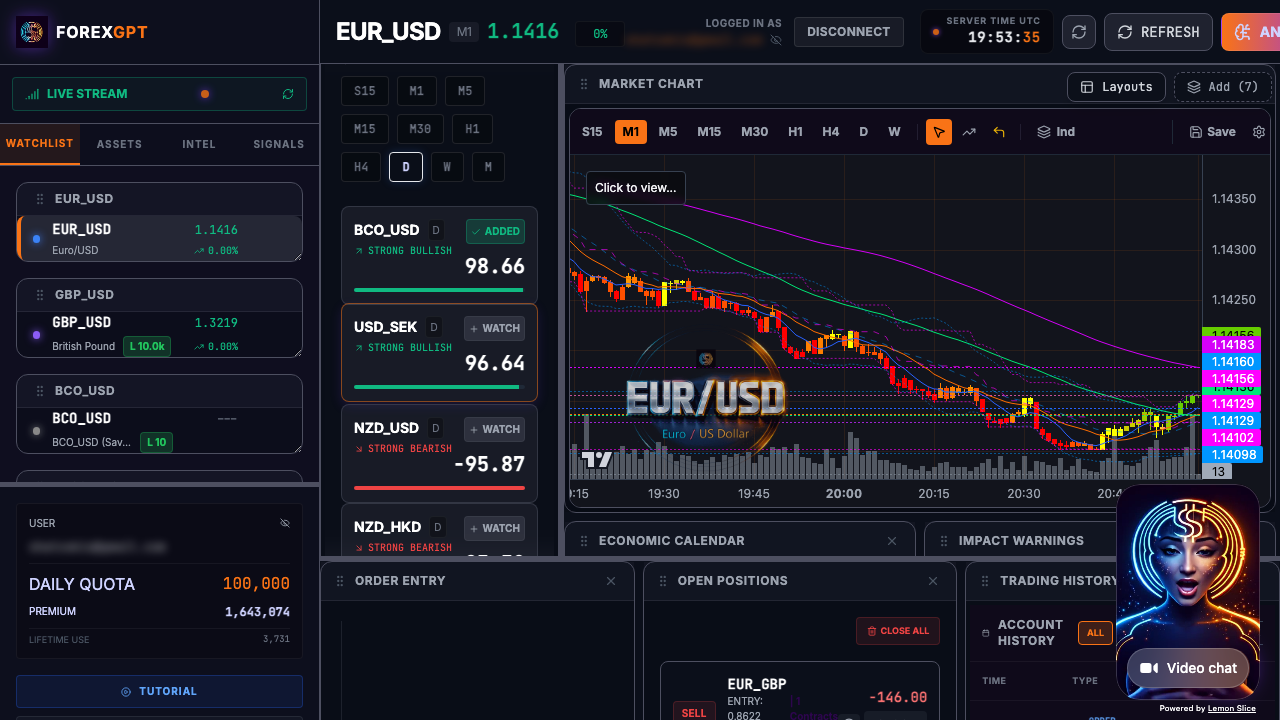
Major pairs like EUR/USD and USD/JPY have high liquidity and frequent price updates. Use the forex market scanner to identify which majors are showing the strongest Sentiment Scores. Scores for these pairs tend to be more responsive due to the volume of price data available.
Crosses and Exotics
Crosses (EUR/GBP, GBP/JPY) and exotic pairs (USD/MXN, EUR/SEK) have lower liquidity. The same technical methodology applies—OHLC data combined with SMAs, Bollinger Bands, and Donchian Channels—though price data may update less frequently for these instruments.
Crypto Pairs
ForexGPT supports 4 crypto assets (including BTC/USD). Crypto Sentiment Scores are derived from the same technical methodology as forex pairs—OHLC data combined with SMAs, Bollinger Bands, and Donchian Channels. Crypto sentiment tends to be more volatile due to larger price swings compared to traditional forex pairs.
Indices and Commodities
Sentiment Scores for stock indices and commodities like gold and oil are derived from the same technical methodology. The scores reflect the technical posture of each instrument based on its OHLC data and core indicators. The heatmap screener provides a visual overview of sentiment across all asset classes simultaneously, while the currency pair analysis tool offers deeper breakdowns for individual instruments.
FAQ
What is market sentiment in forex?
Market sentiment measures whether technical conditions are bullish (positive momentum) or bearish (negative momentum) for a currency pair. In ForexGPT, it's derived from technical context—price position vs Bollinger Bands, SMAs (7, 14, 50, 100), and Donchian Channels. Understanding sentiment helps you gauge the overall technical posture and identify potential opportunities.
How do you measure market sentiment?
In ForexGPT, sentiment is measured through technical context: the OHLC of the last candle combined with SMAs (7, 14, 50, 100), Bollinger Bands (upper, middle, lower), and Donchian Channels (upper, middle, lower). These inputs are normalized into a single Sentiment Score ranging from -100 to +100.
Is sentiment analysis reliable?
Sentiment analysis provides valuable context but should not be used alone. It's most reliable when combined with your own chart analysis and risk management. The Sentiment Score itself indicates signal strength—scores near the extremes (±80 to ±100) represent stronger technical alignment than scores near 0.
How often is sentiment data updated?
ForexGPT's Sentiment Scores are updated as new market data flows into the system. The scanner covers 100 assets across 15 timeframes daily. Scores change as new candle data (OHLC) arrives and technical indicator values shift.
Can sentiment predict market reversals?
Extreme sentiment readings (very high positive or negative scores) can indicate potential reversals, but they don't guarantee them. Sentiment extremes often persist during strong trends. Look for sentiment extremes combined with technical confirmation of reversal patterns—such as bullish divergence on RSI or a double bottom formation—to increase your probability of success.
Do institutional traders use sentiment analysis?
Yes, institutional traders use sentiment data as one input among many. They typically have access to more sophisticated sentiment data sources than retail traders, but the core principles remain the same. Institutions often look for contrarian sentiment extremes combined with technical exhaustion to identify potential reversal opportunities.
How do I use sentiment analysis with my trading strategy?
For trend-following strategies, use sentiment to confirm the trend and avoid countertrend entries. For mean-reversion strategies, use extreme sentiment readings as potential entry signals when combined with technical confirmation. For breakout strategies, use sentiment to filter entries—only trade breakouts that have sentiment support.
What's the difference between retail and institutional sentiment?
ForexGPT's Sentiment Score is derived entirely from technical context (trend, momentum, and range behavior), not from retail or institutional positioning data. The score reflects the technical posture of the asset itself—whether price action and indicator alignment point bullish, bearish, or neutral.
Can sentiment analysis work in all market conditions?
Sentiment analysis is most effective in trending and range-bound markets. During high-volatility events (central bank announcements, NFP releases), price can move rapidly and Sentiment Scores may shift quickly as technical conditions change. In these conditions, monitor Sentiment Score changes and adjust your approach accordingly.
How do I interpret conflicting sentiment signals?
When Sentiment Scores differ across timeframes (e.g., bearish on the 1H but bullish on the Daily), consider the higher timeframe as the primary trend and the lower timeframe as potentially showing a short-term pullback. Scores that align across multiple timeframes carry more weight. ForexGPT's multi-timeframe analysis highlights these differences to help you interpret the overall picture.
About the Author
This article was written by the ForexGPT team, led by Steven Hatzakis—a financial services industry expert with over 20 years of experience in forex and fintech. For a deeper look at the platform architecture and methodology, read the ForexGPT White Paper. For his latest research on AI-driven trading systems, see Steven's paper on Protocol-Constrained Agentic Systems. Explore all guides and tools on the Learn resource hub.
This content was created with AI assistance, reviewed for accuracy by the ForexGPT team, and is updated regularly to reflect current platform capabilities.
Important Disclaimer
ForexGPT is a market analysis tool, not a financial advisor. All content on this page is for informational and educational purposes only. It does not constitute investment advice, financial advice, or trading advice.
Trading forex and other financial instruments involves substantial risk of loss and is not suitable for all investors. Past performance of any analysis tool or signal does not guarantee future results. You should carefully consider your investment objectives, level of experience, and risk appetite before trading.
ForexGPT does not guarantee the accuracy, completeness, or timeliness of any analysis or signal generated by its tools. Always conduct your own research and consult with a qualified financial advisor before making trading decisions.
Ready to Master Sentiment Analysis?
Start using ForexGPT's AI-powered sentiment analysis to enhance your trading decisions today.
Start Analyzing Sentiment - Try ForexGPT Free Today