AI Forex Signals for Real-Time Market Analysis
AI Forex Signals for Real-Time Market Analysis
AI forex signals—also known as ai trading signals forex—are buy/sell recommendations generated by artificial intelligence systems that analyze market data. These ai-generated forex signals use technical indicators, sentiment analysis, and pattern recognition to identify potential trading opportunities.
Unlike traditional signal services that may use fixed rules or manual analysis, AI signals process large volumes of data in real-time and adapt to changing market conditions. They provide traders with timely insights into market direction, strength, and potential entry points.
ForexGPT's artificial intelligence forex signals combine technical analysis with sentiment scoring across 127+ assets. These ai signals for forex trading are designed to augment your analysis, not replace it. Let's explore how AI generates these signals and how to use them effectively.
What AI Forex Signals Are
AI forex signals are automated analysis readings that indicate potential market direction. They are not trade execution instructions—traders must still make final decisions.
How AI Signals Differ from Traditional Signals
Traditional signal services often use:
- Fixed technical indicator thresholds
- Manual chart analysis
- Periodic signal generation
AI forex signals differ by:
- Processing 20+ technical indicators simultaneously
- Deriving a Sentiment Score from technical context
- Generating signals in real-time as data arrives
- Adapting to changing market conditions
How AI Signals Differ from Trading Bots
AI signals provide analysis and recommendations—you decide whether to trade. Trading bots execute trades automatically based on programmed rules.
ForexGPT provides signals, not automated execution. Learn more about how signals differ from bots in our forex trading signals software guide. You can connect your OANDA account to execute trades directly, but you always approve each trade.
How Traders Use AI Signals: A Step-by-Step Workflow
Effective signal trading follows a disciplined process that transforms AI recommendations into well-executed trades.
Step 1: Scan the Market
Start by scanning for active setups across your watchlist or the entire market:
- Trigger a scan: Ask "Scan the market" or use
scan_market - Review signal output: Get direction and Sentiment Score for all assets
- Filter by criteria: Focus on assets with strong Sentiment Scores (above +70 or below -70)
Step 2: Filter and Prioritize
Not all signals deserve equal attention. Filter based on your trading style:
- Sentiment threshold: Focus on signals with Sentiment Score above +70 or below -70
- Timeframe alignment: Check that multiple timeframes agree
- Risk-reward ratio: Consider potential profit versus stop-loss distance
Step 3: Analyze Supporting Factors
Before acting on a signal, understand what's driving it:
- Check supporting indicators: Review which technicals confirm the signal
- Review signal strength components: See which factors are most influential
- Verify with charts: Open the chart analysis tool for visual confirmation
- Check news context: Review economic calendar for relevant events
Step 4: Execute with Confirmation
When all factors align, execute your trade:
- Set stop-loss: Use support/resistance levels or risk management rules
- Determine position size: Calculate based on account risk per trade
- Place entry order: Execute when price reaches your trigger level
- Set take-profit: Use resistance levels or risk-reward targets
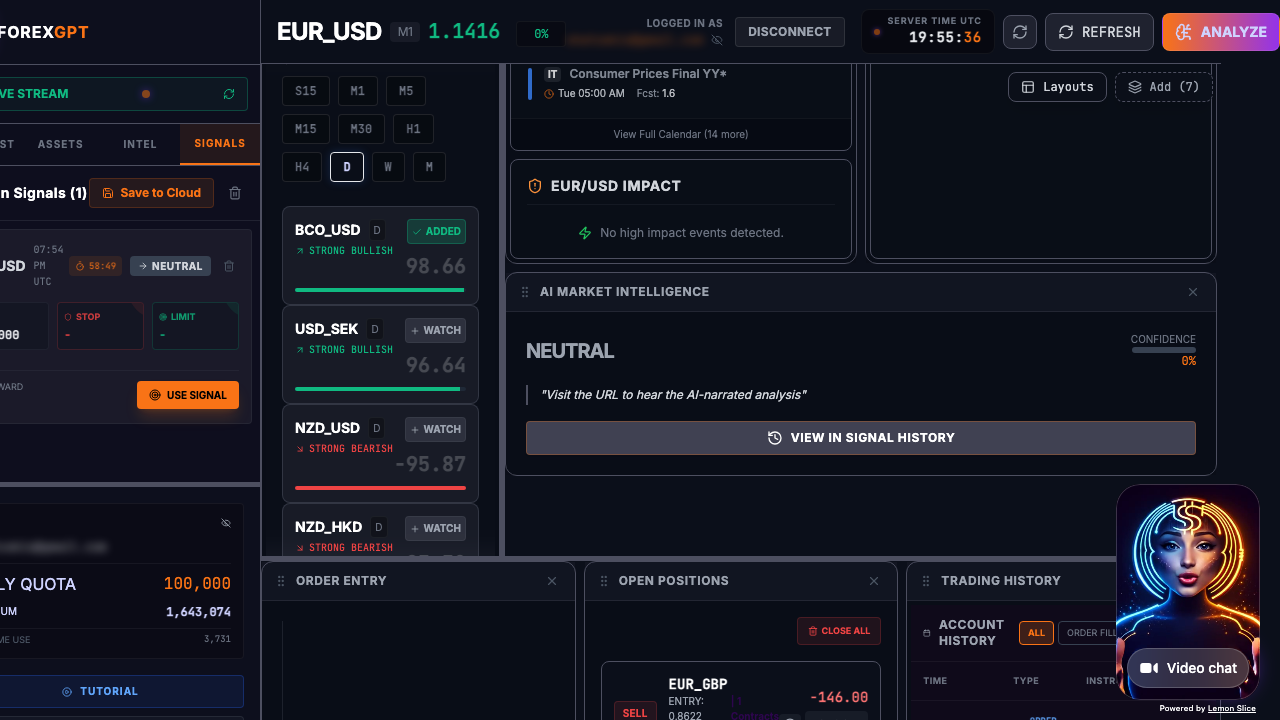
How ForexGPT Generates Analysis Signals
ForexGPT's signal generation follows a systematic approach that combines multiple data sources.
The Signal Generation Process
- Real-time data ingestion: OANDA market data flows into the system
- Technical indicator calculation: 20+ indicators are calculated for each asset — including SMAs (7, 14, 50, 100), Bollinger Bands, and Donchian Channels
- Sentiment Score generation: The system derives a Sentiment Score (-100 to +100) from the technical context
- Signal synthesis: Based on the Sentiment Score, a signal is generated (bullish, bearish, or neutral) with entry, stop-loss, and take-profit levels
This process happens continuously as market data updates.
Signal Output Components
Each ForexGPT signal includes:
- Direction: Bullish, bearish, or neutral
- Sentiment Score: A normalized technical score from -100 to +100 indicating signal strength and direction
- Entry, stop-loss, take-profit: Actionable trade levels
- Supporting indicators: Which technicals are driving the signal
- Timeframe context: Signals across 5+ timeframes
Example Signal Output
A typical signal might show:
Asset: EUR/USD
Direction: Bullish
Sentiment Score: +78
Supporting: RSI crossover, MACD bullish, price above SMA 50
Timeframes: Daily (bullish), 4H (bullish), 1H (neutral)
Entry: 1.0920 | Stop-Loss: 1.0880 | Take-Profit: 1.0990
This gives you context about the signal quality and what factors support it.
Real-Time Signal Updates
Signals update continuously as market data changes. You can:
- Trigger manual scans: "Scan the market" for current signals
- Monitor live updates: Watch signal strength change in real-time
- Set up notifications: Get alerts for significant signal changes (Pro)
Why "AI Signals" Alone Aren't Enough
Many signal services make promises they can't keep. Here's what you need to understand.
The Limitations of AI Signals
AI signals cannot:
- Predict future market movements with certainty
- Account for black swan events
- Guarantee profitable trades
- Replace risk management
They can:
- Process data faster than manual analysis
- Identify patterns humans might miss
- Provide context for your analysis
Understanding the Sentiment Score
ForexGPT's Sentiment Score (-100 to +100) helps you assess signal strength:
- Strong signal (+70 to +100 or -70 to -100): Strong alignment of technical indicators across the analysis
- Moderate signal (+30 to +70 or -30 to -70): Clear but not overwhelming technical evidence
- Weak/Neutral signal (-30 to +30): Conflicting or weak technical signals — ForexGPT may generate a Neutral reading
Weak signals don't mean "don't trade"—they mean "do additional analysis."
Never Use Signals Alone
AI signals should be one component of your analysis:
- Review the signal: What does AI recommend?
- Check the supporting indicators: What technicals confirm it?
- Verify with your chart: Does price action match?
- Consider fundamentals: Any news or events?
- Apply risk management: What's your stop-loss and position size?
CFTC Warnings About AI Trading
The CFTC has issued warnings about AI trading scams that promise guaranteed profits. ForexGPT does not make these claims.
We provide analysis tools that help you make better decisions. We do not guarantee profits or predict market movements.
Using ForexGPT Signals in Practice
Here's how to integrate ForexGPT signals into your trading workflow.
Daily Signal Review
- Morning scan: Run
scan_marketvia the market scanner to identify active setups - Filter by Sentiment Score: Focus on signals with Sentiment Score above +70 or below -70
- Check timeframes: Verify multi-timeframe alignment
- Review charts: Confirm with your own technical analysis
- Add to watchlist: Save promising setups for monitoring with the AI trading assistant
Signal-Based Trading Setup
For a potential trade:
- Signal: Bullish with Sentiment Score of +80
- Confirmation: Price above key moving averages
- Entry trigger: Break above resistance level
- Stop-loss: 1% below entry
- Take-profit: 2% above entry (2:1 risk-reward)
Signal Analysis in the Pro Terminal
The Pro Terminal provides:
- Signal dashboard: View all active signals in the AI trading terminal
- History panel: Review past signal performance
- Widget integration: Signals displayed as visual widgets
- Voice control: "Show me bullish signals" for hands-free review
FAQ
What are AI forex signals?
AI forex signals are buy/sell recommendations generated by artificial intelligence that analyzes technical indicators, sentiment, and market patterns. They provide analysis, not trade execution.
How accurate are ForexGPT signals?
Signal accuracy depends on market conditions. We provide Sentiment Scores (-100 to +100) to help you assess signal strength. No signal service can guarantee accuracy—trading always involves risk.
How often do signals update?
Signals update in real-time as market data flows in. You can manually trigger scans or use the Pro terminal for continuous monitoring.
Can I use AI signals for scalping?
AI signals are designed for analysis across multiple timeframes. For scalping (very short-term trades), use the signals as one input alongside your own technical analysis and speed.
Do you offer signal subscriptions?
Yes. ForexGPT provides signal analysis as part of our platform access. Free tier includes scan_market; Pro provides deeper analysis and historical signal data.
How do AI signals compare to human analysts?
AI signals process data faster and more consistently than human analysts. However, human judgment provides context that AI may miss—market news, central bank policy shifts, geopolitical events. Use both.
What timeframe should I use for signal trading?
For day trading, use 15-minute and 1-hour signals with confirmation from the 4-hour and daily. For swing trading, focus on 4-hour and daily signals with alignment across both timeframes.
How do I interpret conflicting signals?
Conflicting signals often indicate market indecision or a potential reversal. Look for alignment on higher timeframes (daily, 4-hour) to determine the primary trend. If signals conflict across timeframes, it may be best to wait for clearer alignment before entering.
Can I trust weak Sentiment Scores?
Signals with a Sentiment Score near zero mean the technical data is mixed or weak. They don't mean "don't trade"—they mean "do additional analysis." Check supporting indicators, review charts, and consider fundamental context before making a decision.
How do I manage risk with AI signals?
Never risk more than 1-2% of your account on a single trade. Use stop-loss orders, and only trade signals that align with your strategy. Remember, signals provide analysis—not guarantees.
How does the Sentiment Score work?
The Sentiment Score (-100 to +100) is a single normalized technical score that measures both direction and strength. A score of +80 indicates a strong bullish reading, while -80 indicates a strong bearish reading. Scores near zero indicate neutral or mixed conditions.
How do I track signal performance over time?
The Pro terminal includes a signal history panel that shows past signals, their outcomes, and performance metrics. Review this weekly to identify which signal types work best for your trading style.
About the Author
This article was written by the ForexGPT team, led by Steven Hatzakis—a financial services industry expert with over 20 years of experience in forex and fintech. For a deeper look at the platform architecture and methodology, read the ForexGPT White Paper. For his latest research on AI-driven trading systems, see Steven's paper on Protocol-Constrained Agentic Systems. Explore all guides and tools on the Learn resource hub.
This content was created with AI assistance, reviewed for accuracy by the ForexGPT team, and is updated regularly to reflect current platform capabilities.
Important Disclaimer
ForexGPT is a market analysis tool, not a financial advisor. All content on this page is for informational and educational purposes only. It does not constitute investment advice, financial advice, or trading advice.
Trading forex and other financial instruments involves substantial risk of loss and is not suitable for all investors. Past performance of any analysis tool or signal does not guarantee future results. You should carefully consider your investment objectives, level of experience, and risk appetite before trading.
ForexGPT does not guarantee the accuracy, completeness, or timeliness of any analysis or signal generated by its tools. Always conduct your own research and consult with a qualified financial advisor before making trading decisions.
Start Getting AI Signals - Try ForexGPT Free Today